
The Reinvention Lens: How to See Your Life Clearly Enough to Change It

A cornerstone guide from Unbound & Limitless
by Michele Harris, Founder & Life Couch
If you’ve felt stuck for a while, you’ve probably collected a lot of advice.
Make a vision board. Write a five-year plan. Wake up at five. Journal every morning. Follow the seven steps, the twelve rules, the ninety-day challenge. Some of it may even be good. But if you’re like most people who feel stuck, the pile of advice has turned into its own kind of weight. You don’t need more instructions. You already have plenty of instructions.
What you need is to see what’s actually going on.
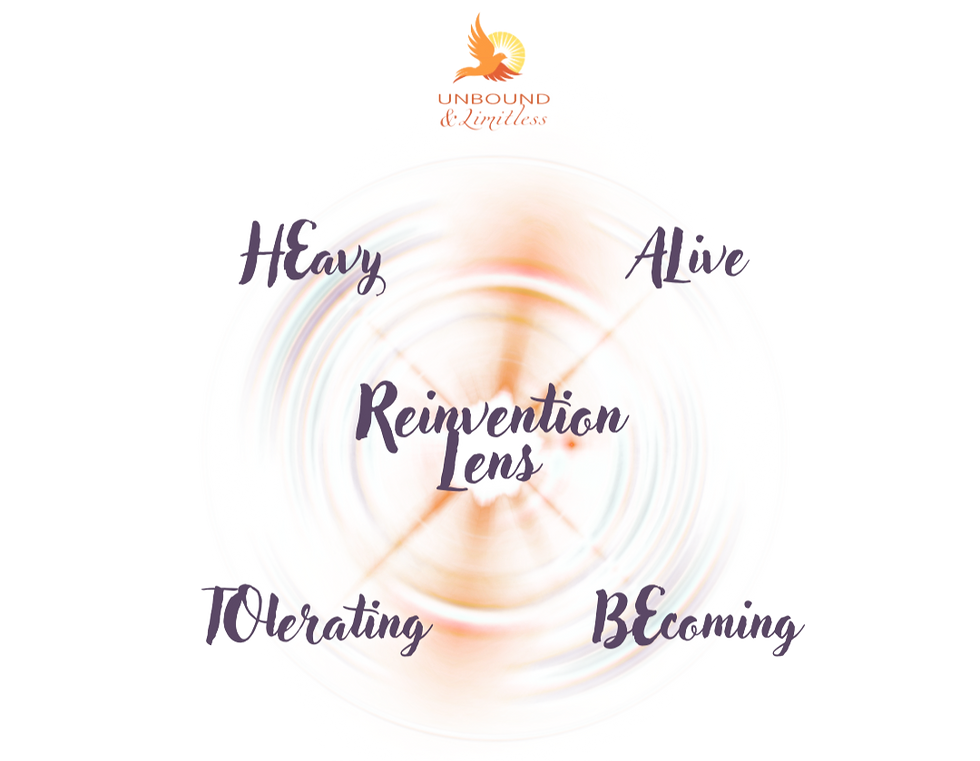
That’s the idea behind what I call the Reinvention Lens. It’s four questions, nothing fancy, the kind a I would ask you over coffee. They work for a career decision, a relationship, a move, or just a sense that something needs to change. And there’s a small secret hiding inside the four words. See if you can spot it before the end.
Let’s walk through it.
Why a lens, and not a system
I chose the word “lens” on purpose.
A system tells you what to do. A lens changes what you’re able to see. And once you can see something clearly, you very rarely need to be told what to do about it.
Systems are wonderful for how-to problems: building a budget, learning software, training for a race. But feeling stuck is almost never a how-to problem. Most of the time you already have a decent idea of what the next step might be. What’s missing is clarity about what’s weighing you down, what you really want, and what you’ve been quietly putting up with.
Here’s another way to picture it. Most of us only ever look at one side of the coin. One side is everything we’ve already experienced. The other is everything we’re afraid might happen next. Fear and anxiety are almost always built out of assumption: imagining the worst version of what’s ahead, based only on what we already know.
But a coin has another side, and it’s made of possibility.
The Reinvention Lens is how you turn the coin over.
The Reinvention Lens at a glance
What It Reveals | |
Heavy | Where you’re forcing, performing, or moving from fear and scarcity |
Alive | What pulls you forward, with no performance attached |
Tolerating | What you’re putting up with, explaining away, or calling “fine” |
Becoming | The direction your daily choices are taking you |
The four questions work as two pairs, and each pair is a compass for a different job.
Heavy vs. Alive is your decision compass. Use it when you’re facing a choice or feeling yourself hesitate. Is this weighing me down and keeping me small, or calling me forward?
Tolerating vs. Becoming is your growth compass. Use it when you’re looking at the bigger picture. What am I putting up with out of habit, and who am I actively choosing to become?
Let me show you how it all fits together, one question at a time.
HEAVY and ALIVE: Your Decision Compass
Question 1: What feels HEAVY?
This is usually the question that stings a little, so we start there.
Where in your life are you forcing something? Where are you white-knuckling your way through and calling it discipline, responsibility, or just being a grown-up, when underneath all that effort it’s really misalignment in disguise?
Here’s how to tell the difference between heavy and hard.
Meaningful effort has its own kind of tiredness. You’re spent, but you feel like you spent yourself on something. You go to bed worn out and a little proud.
Staying somewhere past its expiration date carries a very specific weight, and it’s completely different. It’s the draining heaviness of holding up a job, a relationship, or a dynamic that stopped holding you up a long time ago. You’re tired in a way that sleep doesn’t touch.
The tricky part is that this kind of weight is easy to stop noticing. Nothing has to be dramatically wrong. A life, a relationship, a city, or a role can simply stop fitting, and you keep carrying it because it’s familiar. After enough time, you don’t even realize it.
Decisions made from fear always feel heavy.
When you catch yourself thinking, I’m afraid to leave, or What if there’s nothing better out there? or What will they think? that’s scarcity talking. It’s fear keeping you tethered to a weight you were never meant to carry indefinitely.
And fear is a master of disguise. It rarely announces itself as fear. It feels like what you’re supposed to want, or supposed to do. It dresses up as common sense, logic, and self-protection. It shows up as self-doubt, pressure, people-pleasing, or the anxiety that if you don’t say yes, you’ll miss out or let someone down. It keeps you operating out of obligation and scarcity.
Fear asks you to shrink, and to stay small and safe.
Try this: Scan your week. Which commitments make your shoulders drop when you see them on the calendar? Write down the top three, and for each one ask: Is this heavy because it’s hard and meaningful, or heavy because it’s coming from fear or lack?
Question 2: What feels ALIVE?
This is the question most people skip, and it may be the most important one.
What energizes you? What excites you? Not what’s safest, not what looks good or what you think you should enjoy. What pulls at you, underneath the fear of anyone’s reaction?
Aliveness is usually less grand than people expect. It might be time near water or in nature, live music, being creative, building something with your hands, a certain kind of conversation, or a project or hobby you lose track of time in. It doesn’t have to be impressive or profitable. It only has to be real and make you happy.
Then comes the harder follow-up: when was the last time you actually let yourself do it, instead of just remembering that you used to?
This question is really about granting yourself permission to notice what energizes you and pulls you forward. And the noticing matters, because aliveness is data. It tells you what you value and where your energy wants to go. It is often more reliable than anyone else’s opinion of what you should do, and more reliable than your own fear.
Decisions made from love feel energizing, hopeful, and expanding.
When you tell yourself, I deserve to be happy, or I really want this, or this is better for me in this moment, that’s self-love and possibility talking. Love invites you to come alive and expand.
Love sounds like: I honor myself, and I want to feel alive in my own life, not just present for it.
Try this: Name one thing that makes you feel alive, energized and totally “you” right now- not ten or twenty years ago. Then put a small version of it on your calendar this week.
The Love vs. Fear Filter
Heavy and Alive are the two ends of one very practical question, and it’s the one worth coming back to at nearly every crossroads: Is this decision coming from love, or from fear?
One important clarification. I don’t mean love for the other person, or fear of hurting them. I mean love and fear about the decision itself. Is the choice I’m leaning toward rooted in what I actually want, or in what I’m afraid of?
Here’s how to tell them apart.
| Fear | Love |
In your body | Heavy, tight, in your gut | Light, warm, open, in your heart |
What it says | “I should.” “What will they think?” “What if there’s nothing better?” | “I want this.” “I deserve this.” “This feels like me.” |
Where it comes from | Obligation and scarcity | Expansion and trust |
What it asks of you | To shrink, stay small, stay safe | To come alive and expand |
How it’s dressed | Common sense, logic, responsibility | Hope or certainty, even when it’s scary |
What it keeps you doing | Pleasing, proving, protecting | Creating, exploring, choosing |
The sentence underneath everything
Fear sounds like: What will they think? Will they judge me? Will they still respect me? What if I can’t do it? What if it doesn’t work?
Love sounds like one much quieter sentence underneath all of that: I want this.
When you can’t tell the difference, ask which one is louder in the room: your self-doubt or their possible reaction? Or your own wanting. Whichever one is louder is usually the one that has been driving.
You don’t need a twenty-page pros-and-cons list
When you’re trying to work out which voice is steering, skip the spreadsheet and pay attention to your body.
Fear feels heavy in your gut. Love feels warm and light in your heart. That’s how you know. Follow what feels light.
Picture someone deciding whether to start something new, like a business, a creative project, or a big move. Two conversations are usually running in their head at once.
The fear voice says: Don’t do it. You don’t fully know what you’re doing. What if people judge you? What if you fail? That voice feels constricting, exhausting, and heavy.
The love voice says: I want to build this. I want to make something that matters. That voice feels lighter, warmer, and clearer, even when it’s scary.
You don’t have to silence the first voice. You only have to notice which one you’re taking orders from.
Three important nuances
I don’t want to oversimplify this, because the love-versus-fear filter is only useful if it’s used with care.
1. Scary is not the same as heavy. Love-based choices can be terrifying. Starting a business, leaving a relationship, moving somewhere you know no one: all of it can be terrifying. The difference is what the fear feels like. Scared-and-light says, “I’m afraid, and I want this.” Scared-and-heavy says, “I’m afraid, and I don’t want this, I just think I should.” One is the flutter of standing at the edge of something real. The other is dread.
2. Fear that’s about real danger deserves respect. I’m talking about the fear of risk, judgment, and loss of comfort, and stepping outside what’s familiar, not the instinct that tells you you’re in physical danger. If something feels unsafe, listen, and always put your safety first.
3. Fear is information, too. The bigger the fear, the bigger the signal that whatever’s waiting on the other side matters immensely to your soul. You don’t get terrified over things you don’t care about. Fear isn’t always a stop sign. Often, it’s proof that you’re standing at the edge of something real.
Try this: Think of one decision you’re facing right now, big, or small. A choice about your career, a boundary in a relationship, a commitment on your calendar. Sit with it for a moment and ask: Is this coming from love, or from fear? If it feels heavy, stop and look under the hood. You may find that what you thought was a “must-do” is simply fear that looks like responsibility. Once you clear that away, you give yourself the clarity to find a better, truer path forward, one that honors your time, your energy, and your life.
TOLERATING and BECOMING: Your Growth Compass
Question 3: What are you TOLERATING?
This one is enormous, and it’s usually the one we skip past fastest, because naming it makes it real.
It might be the relationship you’ve quietly explained away for years. The job you’ve outgrown but keep justifying. The body you’ve stopped listening to because listening felt inconvenient. The fear you’ve never said out loud, not even to yourself, because saying it might mean you’d have to do something about it.
Tolerating isn’t always about a job or a relationship
Sometimes it’s tolerating a smaller version of yourself and your own aliveness, because the smaller version is more convenient for everyone, including you.
Many people spend years tolerating a muted version of their own personality. It feels safer and easier, for them and for everyone around them. It’s easier to be agreeable, easier not to want things too loudly, easier to let old hobbies and passions disappear than to make space for them.
This kind of tolerating can show up as habits you keep excusing, like putting your own needs last, saying yes on autopilot, or talking to yourself in a way you'd never talk to anyone else. Or as a dream you've quietly downsized, or a way of being you've settled for because the bigger version felt like too much to ask. None of it announces itself. It just becomes normal.
And sometimes the thing being tolerated is bigger: a gray, going-through-the-motions version of an entire life. Often it takes a real change of scenery, or a real change of routine, before something different feels possible.
Seven places tolerating likes to hide
If your first answer to this question is “nothing, really,” try looking in these places:
1. Relationships. The dynamic you’ve explained away. The conversation you keep not having.
2. Work. The job you’ve outgrown but keep justifying with “at least it pays the bills.”
3. Your body. The signals you’ve been overriding because listening felt inconvenient.
4. Your environment. The place, the home, or the routine that keeps reinforcing the gray. Sometimes self-doubt has a zip code.
5. Small agreements. The yeses that aren’t true. The invitations you accept or decline so you don’t have to deal with the fallout.
6. Your inner stories. The limiting beliefs that are a lie. That you don’t have what it takes, you are not worthy, or that this is as good as it gets.
7. A smaller you. The muted voice, the dimmed personality, the hobbies on the shelf.
The tell: “Fine”
Ask most people what they’re tolerating and the first answer is: Nothing, really, everything’s fine.
That answer is the tell.
“Fine” is almost never actually fine. “Fine” is usually just the sound settling makes when you ask it a direct question. And “It’s good enough” is almost always a fear sentence in disguise.
The friend test
Here’s a simple way to hear “fine” differently.
Imagine someone you love, really love, telling you their relationship is “good enough.” That their work is “at least paying the bills.” That they’re surviving instead of living, and have quietly decided this is as good as it gets.
You would not accept that for them for one single day. You would sit them down and tell them they deserve so much more than good enough. You would tell them that surviving is not the same as being alive.
So why are we so willing to accept exactly that for ourselves?
That question is the whole engine behind what I call the friend test. Before you let a thought, or a whole life arrangement, stand as “fine,” ask: Would I ever accept this for someone I love, without saying a word?
If the answer is no, it doesn’t get to quietly stay “fine” for you either. Not because you’re broken, or ungrateful, or dramatic for noticing the gap. Because you are exactly as worthy of a full, lit-up life as anyone you’ve ever loved.
Now flip it: what are you tolerating by staying safe?
This is the version of the question that changes things for many people.
We usually think of tolerating as something that’s being done to us. But there’s another side. When we stay safe, we’re tolerating something too.
Are you tolerating a quiet, slow-burning numbness just so you don’t have to risk a sharp, short-term disappointment?
Put both costs on the table. The cost of trying something and having it not work out. And the cost of staying exactly where you are, not someday, but right now, this year, in this version of your life. Safe starts to look a lot less safe when both columns are filled in.
Tolerating vs. accepting
A quick but important distinction. Not everything you put up with is something to fix.
Acceptance is chosen, with your eyes open. There are real seasons when getting through is the whole assignment: caring for a sick parent, recovering from a loss, building something that needs a hard stretch of discipline. Surviving in those seasons is its own kind of victory, and it deserves respect, not shame.
Tolerating is endured by default. Nobody chose it. It just kept going because it was familiar and speaking up felt risky.
The test is simple. Did you choose this, and do you know when it ends?
A chosen season has edges. You can say why you're in it, what it's for, and roughly when you'll look at it again. Tolerating has no edges. There's no purpose you could name and no end date, just a quiet "this is how things are" or "this is just how I am." That goes for the habits and patterns inside you, too. A habit you've never questioned isn't something you've accepted. It's something you've tolerated.
Four steps: Notice, Name, Price, Choose
1. Notice. Finish this sentence ten times without stopping to judge: “I’ve been putting up with ______.”
2. Name. Circle the one that makes your stomach flip. Say it out loud, or write it down in your own handwriting. It’s a lot harder to keep calling something “fine” when you can see it in black and white.
3. Price. What is this costing me in energy, joy, health, time, and self-respect? What would I gain if it changed?
4. Choose. You have more options than “stay forever” or “blow it all up.” You can speak up. You can renegotiate. You can change something in yourself. You can release it. Or you can consciously accept it for a defined season. Any of those is a choice, and a choice is the opposite of tolerating.
Try this: Think of one area where you’ve decided, “This is just as good as it gets.” Maybe it’s your health and your body, your job, the depth of connection in a relationship, or a dream you’ve been putting off. Ask yourself: Is that a fact, or have I just stopped asking?
Question 4: Who are you BECOMING?
This is the foundational identity question, and the one the other three rest on.
Who am I becoming?
And then, a clarifier: not who am I convincing. Who am I becoming.
Not who you’ve been. Not who you were trained to be, praised for being, or rewarded for pretending to be. Who you are turning into right now, through the choices you are making today.
You are always becoming someone
Here’s what’s easy to miss: you are always becoming someone. Staying put isn’t a pause. It’s a direction.
If you stay in “good enough” long enough, you’re not standing still. You’re becoming someone who has quietly agreed that they don’t get to have more. And that belief doesn’t stay contained to one relationship or one job. It leaks into how you let people speak to you, what you think you’re allowed to ask for, and how big you let yourself dream out loud.
Settling isn’t a pause button. It’s still a direction. It’s just facing the wrong way.
The mirror question
Look at where you’re spending your energy, the decisions you’re making, and how you’re living. Then ask:
Is this current path turning you into the highest version of yourself, living your best life?
Or is it shrinking you into a guarded, exhausted version, forced into survival mode?
If you looked in the mirror tonight, would you see someone who’s thriving, or someone who’s just getting through the day?
That question doesn’t require a strategic plan. It just requires you to look.
Most people can feel the difference. Some days you catch yourself in a reflection and see someone worn down, defeated, a little hollowed out. Other days you see someone who looks like they’re headed somewhere. Neither is a verdict. Both are information about direction.
Becoming is built from a hundred quiet choices
Reinvention is never one dramatic decision. It’s a hundred quiet ones, stacked on top of each other, until one day you look up and realize you’ve become someone entirely different.
The choices that build a new direction are almost always small. Keeping a promise to yourself for a second week. Saying no to something you'd normally agree to out of habit. Speaking up in a conversation where you'd usually stay quiet. Protecting one hour for something that matters to you. None of it looks dramatic from the outside, and all of it is becoming. Each small choice is a vote for the person you're turning into.
Beliefs are the architecture of who you’re becoming
Behind every choice is a belief about what you’re allowed to have. Changing direction often means deliberately claiming a new belief before you have evidence for it. You are allowed to outgrow people, paths, and past versions of yourself.
You don’t have to believe a new belief fully on day one. You only have to be willing to act as if it might be true, and then let your life collect the evidence. That’s the part most people have backwards. They wait for proof before they’ll try on the belief. It usually works the other way around.
Ask it both ways
Two versions of the question I use in big moments:
• Who am I becoming if this works? Not just who I become by trying, but who I am on the other side of it landing. It makes the full size of a dream real in a way hedging never could.
• Who am I becoming if nothing changes? This one is uncomfortable, and useful.
The honest truth about identity
Here’s something almost nobody warns you about. Changing your circumstances is only half the work. The harder half is updating your internal identity, so that you don’t accidentally sabotage the very freedom you fought so hard to build.
You can leave the job, end the relationship, move across the country, and still carry the old version of yourself into the new life. It takes time for who you are to catch up with where you are. That’s normal. It’s also why I think reinvention is a practice, not an event.
Reading Your Answers Together
The four questions are most useful side by side. Once you’ve answered them, look for the pattern. A few common ones:
Heavy and Alive point in different directions. This is the clearest signal there is. The heavy thing is where you’re spending your energy. The alive thing is where your energy wants to go. The gap between them is the work.
Plenty feels heavy, nothing feels alive. This is usually depletion, not a lack of desire. Start by lightening one heavy thing, then give aliveness room to come back in small doses.
Your Tolerating list is long. Look for the one item that shows up in several places. It’s often a single unspoken belief, like I shouldn’t want more, wearing different costumes.
Your Becoming answer surprises you. That’s the lens doing its job. If the person you’re turning into isn’t someone you’d choose, you don’t need a dramatic overhaul. You need one small decision that points the other way.
The lens won’t make the decision for you. What it does is show you where the decision already is.
How to Use the Reinvention Lens in Real Life
The 10-Minute Audit
If sitting down with four questions feels like too much, start here.
Grab a sticky note or open the notes app on your phone. Write down one thing you’re tolerating right now. Next to it, write one thing that makes you feel alive.
That’s it. You don’t have to fix anything today. Naming both on the same piece of paper breaks the sleepwalk. When you see them side by side, it gets harder to pretend nothing needs to change.
A weekly check-in
Once a week, take five minutes with these four prompts:
• HE: What felt heavy this week? Was it hard-and-meaningful, or heavy-and-draining?
• AL: What felt alive? What was fun? What can I do more of?
• TO: What am I tolerating – in a situation or in myself- that I can name out loud?
• BE: Who am I becoming? What small choice this week moved me toward who I want to be?
For a big decision
Write the decision at the top of a page, then:
1. Which option feels heavy? Which feels alive?
2. Which option is coming from fear, and concern over their possible reaction? Which option is coming from love and my own wanting?
3. What would I be tolerating by choosing the safe one?
4. Who would I become by choosing each?
You may notice you already know the answer. That’s what the Lens does.
Common Questions
“What if everything feels heavy?” Start with the one thing that feels heaviest and look for what it’s holding up. Often a single heavy commitment is draining energy that spills into everything else. You don’t have to fix it all. Shift one thing and watch what happens to the rest.
“What if nothing feels alive?” That happens, especially after a long stretch of going through the motions. Start small. Go back to what you loved as a kid, or to what you used to enjoy before you got so busy being useful. Do a tiny, low-stakes version this week. If the flatness lasts a long time or feels like more than a rut, it’s worth talking with a doctor or therapist. That’s a sign of caring for yourself, not a failure of the Lens.
“Isn’t this just following my feelings?” Not exactly. Your feelings are data, not a dictator. The lens asks you to notice what you feel, then look at the story behind it. Fear can feel very convincing. Love can feel very quiet. The practice is learning to tell them apart, not to obey whichever is loudest.
“What if what feels alive isn’t practical?” Then find the smallest practical version and start there. A calendar block. A single weekend. A tiny experiment. The goal isn’t to leap blindly. It’s to stop letting “impractical” be a polite word for “afraid.”
“What if heavy and alive point to the same thing?” It happens. A big dream can feel exciting and overwhelming at the same time. Run the filter on the fear part: is it dread, or is it the flutter of standing at the edge of something real and exciting?
The Practice, Not the Crisis Tool
One last thing. I don’t think of the Reinvention Lens as something you reach for only when life falls apart. It’s a practice for an ordinary life, the kind you actually want to enjoy living in.
The people who get the most from the lens use all four questions most weeks, and not because they’re stuck. They use them because the questions keep you awake inside your own life instead of sleepwalking through it, even on the Tuesdays when nothing is technically wrong.
You don’t have to answer them perfectly. Ask the honest question, name the honest truth, and let the answer be whatever it is, even when it’s inconvenient. That’s the whole practice.
One More Thing: The Secret Inside the Words
Did you spot it?
Look at the first two letters of each question. Read the top row, then the bottom row, the way you’d read a sentence:
HEavy. ALive. TOlerating. BEcoming.
HE. AL. TO. BE.
Heal to be.
It wasn’t planned at all. I introduced this Lens in Season Two of my podcast. I noticed this message afterwards when I crafted this guide. And the more I’ve sat with it, the truer it feels.
It’s worth being clear about what “heal” means here, because the word can sound heavy - and not in the way we’ve been talking about. I don’t mean you’re broken, and I don’t mean something is wrong with you that needs fixing. I mean something gentler. It’s the way a tight, guarded part of you softens when you finally stop carrying what was never yours to carry. It’s what happens when you put down the weight, follow what feels alive, stop tolerating the smaller version of your life, and start choosing who you’re becoming.
When all of that falls away, what’s left is you.
That’s what reinvention really is. Not building a brand-new person from scratch, but clearing away all the stuff that was layered on top until the real you can breathe.
So that’s the whole practice, and the whole point: Heal to be who you are.
Listen to the Podcast and hear how I use the Reinvention Lens in my life.
If this resonates, my free guide, “Why You Still Feel Stuck,” goes deeper into the hidden patterns underneath whatever you find when you use the lens. You can download it here - free and great place to start.
And if you’d like to walk through the Reinvention Lens with someone beside you, I’d love to talk in a complimentary Breakthrough Session.
Sending love and light.💖✨
Michele Harris is a life reinvention coach, founder of Unbound & Limitless and creator of the URISE Method™. Michele helps people who feel stuck break free from what's holding them back so they can finally experience the love, confidence, success, peace, and fulfilling life they truly want. unboundlimitless.com


Comments